
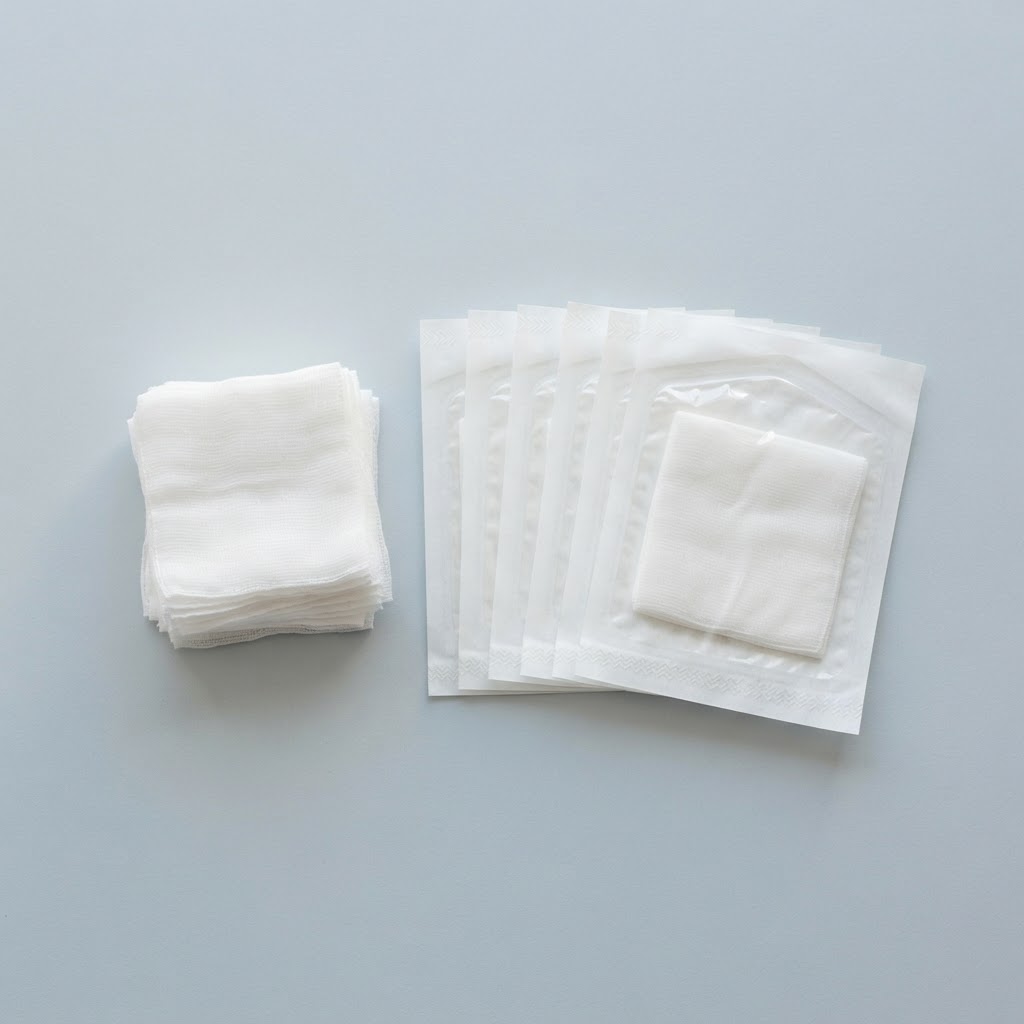
On a crowded shelf, a box of sterile gauze pads and a sleeve of nonsterile ones can look nearly identical: white, square, folded and the same size. The difference is printed on the package, and it is a difference procurement has to get right every single time.
This article doesn’t say when sterile gauze is needed. That is a clinical decision governed by your protocols. It is about making sure the product on the shelf matches the product that was specified.
What “sterile” means on a label
A product labeled sterile has been through a sterilization process and is packaged to stay sterile until the package is opened or compromised. For devices labeled as sterile, FDA reviews sterility information as part of premarket submissions. For a purchaser, the label is the evidence: if a package doesn’t say sterile, treat the product as nonsterile.
Sterility also depends on what happens after the product leaves the manufacturer. Packaging protects its contents only while it stays intact and dry, which is why sterile products commonly warn against use if the package is damaged or open, and why receiving and storage are part of the same chain. CDC’s Disinfection and Sterilization Guideline is a core U.S. reference for how healthcare settings handle sterile items.
Details to match, line by line
- Sterility. Sterile or nonsterile, as stated on the package.
- Pack format. Sterile gauze often comes in peel-open pouches holding one or two pads, while nonsterile gauze often comes in bulk sleeves or bags. “Sterile, 2 per pouch, 25 pouches per box” and “nonsterile, 200 per sleeve” are very different orders. For example, Kendall Curity Sterile Gauze Sponges come two to a peel-back package, 25 packages to a box, while Kendall Versalon Gauze Sponges are nonsterile and sold in packs of 200.
- Size and ply. Dimensions and ply count, the number of layers, are part of the specification clinicians chose.
- Material. Woven cotton and nonwoven blends behave differently.
- Lot and expiration. Sterile products commonly carry both; record them for the items you track.
- Package integrity. Torn, wet or compromised sterile packaging should be set aside according to your policy.
Why this belongs to procurement
Clinicians decide which product a task needs; purchasing decides what actually arrives. When the two drift apart, the person who discovers the gap is usually a clinician in the middle of a task. A precise reorder line and a careful receiving check move that discovery to the supply room, where it costs a phone call instead of a delay.
Avoiding the look-alike problem
- Store sterile and nonsterile versions in clearly separated, labeled locations, not side by side in one bin.
- Put “sterile” or “nonsterile” in the item name on your reorder list, so the word can’t be dropped.
- At receiving, check sterility on every line, not just the product name.
- When a supplier proposes a substitute, confirm its sterility, size, ply and pack format before accepting it.
An illustrative mix-up
An illustrative clinic reorders “4x4 gauze” from memory. The order arrives as nonsterile bulk sleeves instead of the sterile two-pad pouches the treatment room uses, and nobody notices until the sterile stock runs out mid-week. The fix wasn’t clinical knowledge. It was a reorder line that said “sterile, 2 per pouch” and a receiving check that read the label.
Make the order line survive a handoff
A useful order line should still be understandable when the usual buyer is absent. Write the manufacturer item number alongside the dimensions, ply, material, labeled sterility and packaging format. Record both the number of pads in each inner package and the number of packages in the selling unit. This prevents “one box” from becoming an ambiguous instruction.
For an illustrative comparison, a box containing 25 pouches of two pads contains 50 pads. That arithmetic helps compare quantities; it does not make those pads interchangeable with a bulk nonsterile product. The clinician-selected specification remains the starting point, regardless of apparent unit-price savings.
Keep packaging questions out of the treatment room
Decide where staff should place a questionable package and whom they should notify. A damaged carton and a compromised sterile barrier are not necessarily the same observation, so describe what is actually visible rather than guessing whether the contents remain suitable. Follow the manufacturer instructions and your facility’s policy for disposition.
At the shelf, labels should identify the item clearly without covering information needed from the original package. Keep the package information available until required lot, expiry and receiving details have been recorded. When supplies move between rooms, preserve that identification rather than relying on appearance. The receiving checklist helps move these checks earlier in the purchasing process.
The takeaway
Sterile and nonsterile gauze are different products that happen to look alike. Name sterility, pack format, size and ply on every order line, store the two apart and check the label at receiving.
Nuvex Medical product pages list each item’s specifications and pack size. Before opening a sterile item you might want to return, note that opened sterile and single-use items can’t be returned unless they arrived damaged, defective or incorrect; our returns policy has the details. Browse wound care.
Sources
Examples in this article are illustrative, not data from real customers or suppliers. This is general information, not clinical, legal or regulatory advice. Always follow the manufacturer’s instructions for use and your organization’s policies.


